
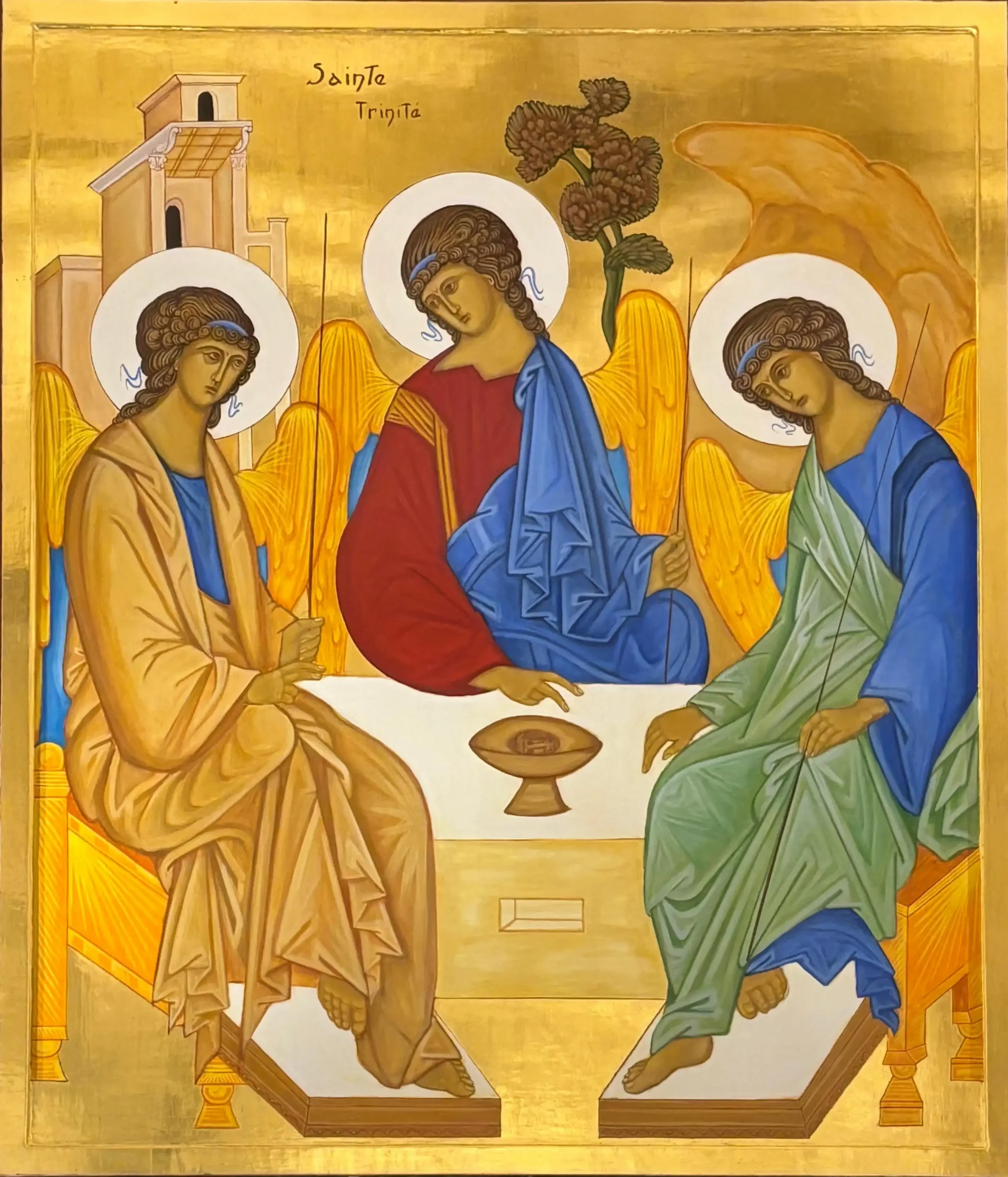
Based on the famous Trinity Icon by Roublev, this work by Jean-Marc Vingerhoets, displayed in the sacristy, depicts the visit of three angels to Abraham, an iconic scene from the Old Testament (Gn 18:1-8).
In the Bible : Abraham and the Trinity in the icon by Jean-Marc Vingerhoets
This representation is inspired by a chapter from the Book of Genesis : God comes to meet Abraham. While the Bible constantly reminds us of the uniqueness of God, Abraham sees three Persons coming to meet him here : “Now the Lord came to him by the holy tree of Member, when he was seated in the doorway of his tent in the middle of the day ; And lifting up his eyes, he saw three men before him ; and seeing them, he went quickly to them from the door of the tent, and went down on his face to the earth ; And said, My Lord, if now I have grace in your eyes, do not go away from your servant“ (Book of Genesis, chapter 18, verses 1 to 3). Is Abraham facing the one God or a Trinitarian manifestation?
Patristic readings analyse this text as one of the revelations of the Trinity : God is one in his divine essence, but revealed in three Persons, the Father, the Son and the Holy Spirit. It is this theological dimension that Jean-Marc Vingerhoets highlights in his interpretation of Rublev’s icon.
The Trinity in Jean-Marc Vingerhoets’ icon
The icon does not represent Abraham. It places the viewer in front of the three angels, as if we were in his place. This posture invites contemplation: what Abraham sees, we are called to see as well.
The three angels are very similar: they have the same facial features and the same posture. In this way, the icon signifies the unity of the Trinity: when we see one Person of the Trinity, we see the whole Trinity.
The icon of the Trinity : a reversed perspective
Iconographic art reverses perspective, unlike classical art. Indeed, the vanishing point – where the various lines converge – is not inside the work (behind the figures depicted), but in front of the work, outside it.
This reversed perspective has a purpose : to draw us into the mystery depicted. The softness of the faces and the silent harmony of the gazes invite us to an inner encounter.
Jean-Marc Vingerhoets, creator of the Trinity icon
Jean-Marc Vingerhoets is an oblate of the Benedictine Abbey of Chevetognes in Belgium. He has addressed more than 70 biblical and liturgical themes, giving lectures in France and Belgium since 1996. This tempera and gilding on oak wood, created between 2015 and 2025, was based on the famous icon by Andrei Rublev.


